Since the Renters’ Rights Act came into force on 1 May 2026, every rent increase in England has to go through the formal section 13 process. Any tenant can ask the First-tier Tribunal to decide whether the new rent is fair.
Tenants are using that right. Tribunals made 195 rent decisions in September alone, against an average of 48 a month before the Act. The headlines have been stark. Analysis of HMCTS data reported by The Telegraph found that tribunals set rents below what the landlord asked in 466 of 668 cases (70%). In 6% of cases, the rent ended up lower than the tenant was already paying.
That last figure catches landlords off guard. In Manchester, a landlord asked for an extra £50 a month on a well-kept two-bedroom flat. The tribunal preferred the tenant’s evidence of nearby achieved rents and set the rent at £1,450. That was £200 below what the tenant had been paying.
So is the tribunal simply siding with tenants? We wanted to know what’s actually happening on our own doorstep, so we read every decision we could find for Wandsworth, Lambeth and Merton cases published since 1 May.
What we found locally
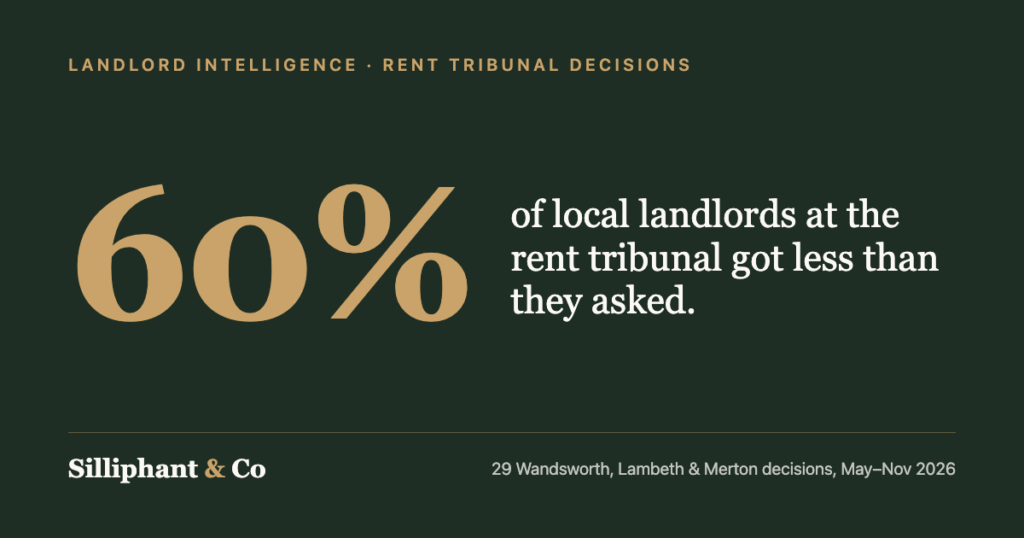
We found 29 local cases, and the tribunal set a rent in 25 of them.
- 15 landlords (60%) got less than they asked for. One got no increase at all.
- 10 landlords (40%) got the full increase. Three got more than they asked for, which was still possible under the old rules for notices served before 1 May.
- None had their rent cut below what the tenant was already paying.
- In three more Wandsworth cases, the increase failed before anyone looked at the rent, because the notice itself was invalid.
The picture locally is less one-sided than the headlines suggest. But the pattern is clear: the tribunal doesn’t side with tenants, it sides with evidence. Landlords who arrived with a reasonable figure, a well-kept home and real comparables usually got what they asked for. Landlords who didn’t, didn’t.
Five lessons from the decisions
1. A notice with one wrong date is worth nothing
In Battersea, a landlord served the right form with more than two months’ notice. But the new rent was set to start on the 23rd of the month when it needed to start on the 20th, the first day of a rental period. The notice was invalid, the tribunal had nothing to decide, and the rent stayed at £2,150.
In Wimbledon Park, a tenant challenged a notice that gave less than the required notice period. In Tooting, the tribunal never received a valid notice at all. That makes three of the 13 Wandsworth cases we found where the rent stayed the same purely because of the paperwork.
The rules are strict: Form 4A, at least two months’ notice, a start date at the beginning of a rental period, and no more than one increase a year. Getting them right costs nothing. Getting them wrong costs a year’s increase.
2. Asking rents aren’t evidence. Achieved rents are.
Tribunals give little weight to listings that are only being advertised. They want to know what similar homes actually let for, and how they compare in size, floor, condition and furnishing.
In one Queenstown Road case, the landlord’s comparables were given limited weight. There were no floor plans and no details of condition, outlook or furnishing, and one was in a different building. The rent was cut from the £2,665 asked to £2,550.
Where neither side brings good evidence, the tribunal relies on its own knowledge of the local market. That means you’ve lost control of the outcome before the case starts.
3. Condition is priced in, pound for pound
The tribunal usually starts from what the home would let for “modernised and in good order”, then deducts for anything that falls short.
- Nappy Valley, SW11: a family house let at £2,750. The landlord asked for £4,000. The tribunal agreed £4,000 was right for the home in good condition, then took off £350 for worn carpets and other wear. The new rent was £3,650.
- Tooting, SW17: a flat let at £1,575. The landlord asked for £2,200, a 39% jump. The tribunal took off £525 for condition and set £1,975.
- Herne Hill, SE24: £300 a month was deducted for excess cold, damp and mould.
Every pound spent putting right the issues a tenant can photograph is likely to come back at a rent review.
4. Big catch-up rises are where landlords lose most
Many of the biggest cuts came where rents had been left untouched for years and the landlord then tried to close the whole gap in one go. Rises of 30–40% invite a challenge, and they put the home’s condition under a microscope.
The landlords who got their full increase mostly asked for something modest and evidenced. A Putney flat went from £1,550 to £1,650, granted in full even though the tenant raised mould. The tribunal put the market rent at £1,900–£2,000, so £1,650 was comfortably fair. A Stockwell flat went from £2,375 to £2,450, and a Brixton flat from £2,050 to £2,200. Both were granted.
Regular, reasonable reviews are easier to defend than a big catch-up rise, and they’re kinder to good tenants you want to keep.
5. Under the new rules, you can’t win more than you ask for, and you can’t backdate
Before May, a tribunal could set the rent above the landlord’s figure. One SW11 landlord asked for £1,457 a month and the tribunal set £2,350, because that was the market rent. For notices served since 1 May, the tribunal can no longer go above the figure in your notice. Ask too low and you’ve set your own ceiling for the year.
The new rent also now starts only from the date of the decision, not the date in your notice. In the Tooting case, the landlord wanted the increase from 10 July. The decision came on 5 October, so that was nearly three months of the old rent.
Winning at being a landlord
A big part of our job isn’t just finding a tenant. It’s helping landlords get the most from their investment over the whole tenancy, and avoiding a dispute in the first place.
For the homes we let, that means:
- Starting at the right rent. A well-presented launch, with every home filmed, attracts the strongest tenants at full market rent, so you’re not playing catch-up later.
- Keeping the home tribunal-ready. We help you spot the small issues worth fixing before they cost you every month.
- Reviewing rent every year on real evidence. We set a figure from achieved local rents, not optimistic asking prices, and record why it’s fair.
- Getting the notice right. We check the form, the dates and the notice period, every time.
- Talking to your tenant first. Most disputes start with a surprise. A clear, early conversation backed by evidence keeps good tenants and avoids the tribunal altogether.
The tribunal isn’t against landlords. It’s against weak evidence, poor condition and sloppy paperwork. All three are avoidable.
Thinking about a rent review, or wondering what your home would let for today? Book a complimentary Rental Position Review. Adam will give you a current rental valuation, a letting strategy review and a Renters’ Rights compliance check, in writing within 24 hours.
Sources
- SOURCES
- GOV.UK Residential property tribunal decisions register (Rents – market rent), Wandsworth (LON/00BJ), Lambeth (LON/00AY) and Merton (LON/00BA) decisions published 1 May – 4 Nov 2026. Cases cited include LON/00BJ/MRA/2026/0262 (SW11 5SR, invalid notice), LON/00BJ/MNR/2026/0173 (SW19 6TA), LON/00BJ/MNR/2026/0179 (SW17 7HS), LON/00BJ/MNR/2026/0439 (SW11 8NT), LON/00BJ/MNR/2026/0377 (SW11 6QS), LON/00BJ/MRA/2026/0014 (SW17 0UB), LON/00AY/MNR/2025/0908 (SE24 9QY), LON/00BJ/MRA/2026/0180 (SW15 6UA), LON/00AY/MRA/2026/0278 (SW8 2AY), LON/00AY/MRA/2026/0074 (SW9 0RG), LON/00BJ/MNR/2026/0158 (SW11 5UY).
- The Telegraph via Yahoo News, “Landlord rent rises rejected in 70pc of tribunal cases”, 2 Nov 2026 (HMCTS data, Landlord Sums analysis).
- NRLA, “Warnings as rent appeal upheld”, 22 Oct 2026.
- GOV.UK, Assured periodic tenancies: rent increases guidance.